How Do Real Estate Agents Get More Listings and Buyers Online?
Real estate agents get more listings and buyers online by doing three things consistently: being findable when someone searches for an agent in their area, capturing every inquiry and following up within minutes, and publishing steady proof of local knowledge so strangers trust them before they call. Everything else — ads, social, email — works only when those three are in place.
This guide is written for a small-business owner, not a marketer. The same moves that fill a barbershop's chairs or a gym's classes fill an agent's calendar: a clear offer, a findable local presence, fast replies, and content that shows real work. Below are the concrete steps, a simple comparison, and an honest look at what does not work.
Start with the two lists every agent actually needs
Before touching any tool, write down two lists. This is the same discipline a bakery uses when it separates "people who walk past the window" from "people who order cakes."
- Listings list: every homeowner in your farm area you can reach — past clients, people who asked about selling, expired listings, and neighbors of homes you've sold. These are your seller leads.
- Buyers list: everyone who has ever asked you about buying, plus people who respond to your content or ads. These are your buyer leads.
Then add one column to each: last contact date. Most agents lose deals not because they lack leads but because nobody followed up. A barbershop keeps a list of regulars and texts them when it's been six weeks; an agent should do the same with anyone who expressed interest.
Concrete step: put both lists in one spreadsheet today, with name, contact, area of interest, and last contact. That single file is worth more than any new app.
Be findable when someone searches "estate agent near me"
Most buyers and sellers start with a search. If your name and area don't show up, the inquiry goes to whoever does. This is the same as a gym that never appears when someone searches "gym near me" — the equipment doesn't matter if nobody finds the door.
Do these in order:
- Claim and complete your Google Business Profile. Real address, service area, hours, phone, and photos of you and your listings. Ask every happy client for a review — honestly, one at a time, never bought or invented.
- Make one page per area you serve. "Selling a house in [neighborhood]" beats a generic homepage, because it matches what people actually type.
- Put your phone number and a short form on every page. A barbershop loses walk-ins if the door is hard to find; a website loses leads if contacting you takes more than one step.
- Keep your listings and hours current. Stale information is worse than none — it signals you're not active.
Checklist: profile complete, reviews requested weekly, one area page per neighborhood, contact on every page, hours and listings updated monthly.
Reply fast, then follow up on a schedule
Speed is the cheapest advantage you have. When a buyer fills in a form or a seller calls about a valuation, reply the same day — ideally within the hour. A bakery that answers a wedding-cake inquiry two days late has already lost the order to the shop that replied in ten minutes.
Set a simple follow-up rhythm and stick to it:
- Day 0: reply, answer the question, offer a call or a viewing.
- Day 2: one short message — "Did you get a chance to think about it?"
- Day 7: send something useful — a comparable sale, a new listing that fits, a market note.
- Monthly: a short email with local market facts and one or two listings.
Write the messages yourself or template them, but keep them personal. "Hi Sarah, saw you're looking in [area] — this one on [street] just came up, want a look Thursday?" beats any mass email.
Publish proof of local knowledge, not hype
Buyers and sellers trust agents who clearly know the area. The cheapest content is what you already do: viewings, sales, local facts. A gym posts members' progress; an agent posts sold prices, neighborhood notes, and what a street is really like.
What works, in plain terms:
- Short videos of you walking a street or a listing, saying what's good and what isn't.
- Local market notes — recent sale prices in a neighborhood, with the source named.
- Client stories — with permission, and only real ones.
What to avoid: invented statistics, fake reviews, and "luxury lifestyle" posts that say nothing. If you state a number, be able to point to where it came from.
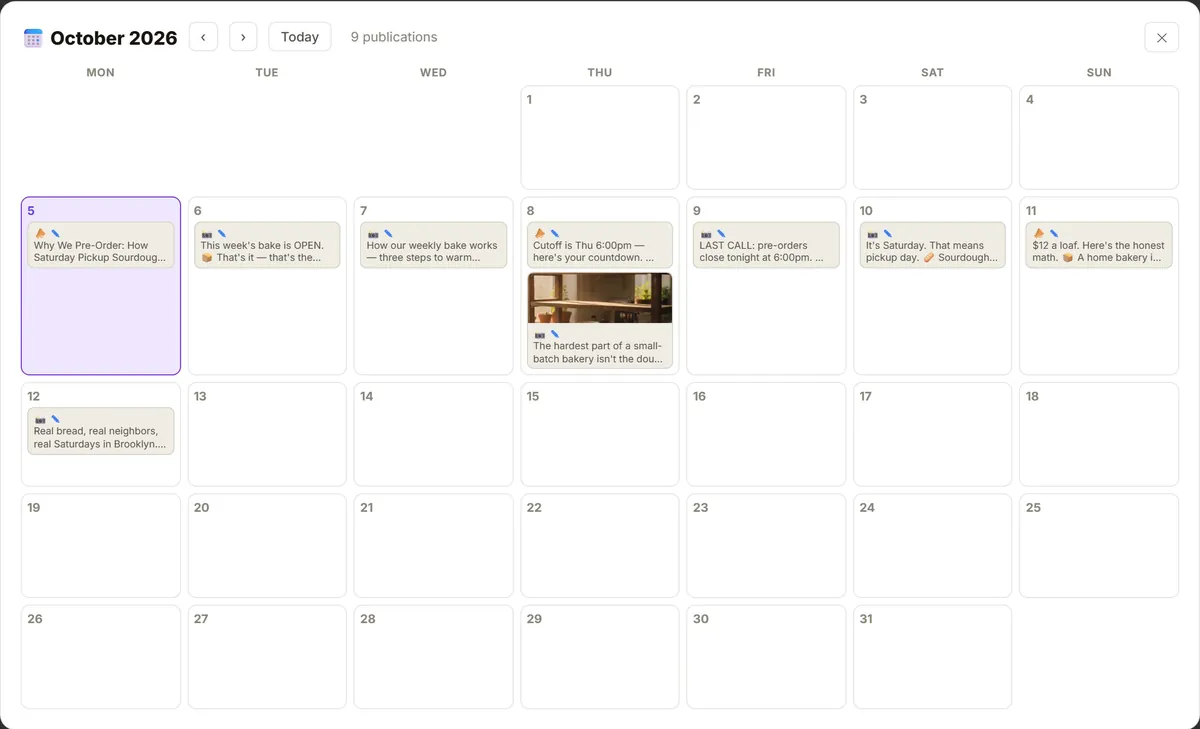
One practical shortcut: a single page of your website — your area page or a listing page — can be turned into a month of posts, each with its own picture, planned day by day. That is exactly what Agentica does: paste a link and it writes a month of posts from what the page actually says, and nothing is published until you approve it.
Use tools that do the repetitive work — and check them
You don't need ten tools. You need something that handles the boring parts: finding local leads, drafting personal emails, planning posts. Compare the options honestly:
| Approach | What it does | Watch out for |
|---|---|---|
| Do it by hand | Full control, personal | Eats hours; easy to skip follow-up |
| Generic email blaster | Sends fast to many | Impersonal, can hurt your reputation |
| Social scheduler | Posts on time | Still needs content written |
| AI agent team (e.g. Agentica) | Finds local leads, drafts personal emails, plans posts and short videos from your site | You still approve everything; results depend on your offer and market |
Agentica (ai-biz.dev) fits here if you have a website and want the repetitive work handled: it reads your site, finds real local businesses on Google Maps with public emails, and writes each a personal email — all waiting in an approvals inbox. It also plans a content calendar and makes short videos from your own live website, using only facts you state. It does not guarantee sales, and it never sends or publishes anything without your approval. Plans start at €12/month for Starter (30 credits, 3-day free trial), €29/month for Pro, and €79/month for Agency.
What does not work (be honest with yourself)
Some things sound good and don't deliver. Skip them:
- Buying email lists. They're full of people who never asked for you, and they damage your name.
- Fake reviews or invented sold prices. They get caught, and trust is the whole business.
- Posting without following up. Content that brings inquiries you never answer is wasted.
- Chasing every platform. One area page and one social channel done well beats five done badly.
- Expecting a tool to replace the relationship. Software can find leads and draft emails; only you can show a house and earn the listing.
Also true: results depend on your offer and your market. A tool does real work — leads, emails, posts, edits — but it does not create demand where none exists.
Official guidance: Tips to improve your local ranking on Google (Google Business Profile Help) · SEO Starter Guide (Google Search Central) · Directive 2002/58/EC on privacy and electronic communications (EUR-Lex (Official Journal of the EU))
Frequently asked questions
How quickly can an agent get more listings online?
Findability and reviews take weeks to build; fast replies and follow-up can produce inquiries within days. Most agents see the first real change after a month of consistent work.
Do I need to pay for ads?
No. A complete Google Business Profile, area pages, reviews, and steady content bring inquiries without ads. Ads help once those basics work.
What should I post as a real estate agent?
Local market notes with named sources, short videos of streets and listings, and real client stories with permission. Avoid invented numbers and hype.
Can AI write my emails and posts?
Yes, it can draft them from your website and real facts. You should still read and approve each one before it goes out in your name.
Is there a free way to try Agentica?
There is no free plan. The way to try it is the 3-day free trial of Starter at €12/month — a card is required, and if you cancel before the trial ends you pay nothing.